The direct answer
A custom glass cabinet brief should settle what is being displayed, the required transparency, the safety-glass build-up, panel sizes, edge finish, door hardware, shelf supports, lighting, ventilation, cleaning access and acceptable visual quality before any glass is ordered. Glass cannot be treated like a timber shelf that can be adjusted casually on site. Holes, notches, hinges and support positions influence fabrication, while edge damage and point loading influence performance. Freeze the complete assembly and assign responsibility for checking glass, hardware and joinery as one system.
Begin with the objects, not the glass colour
List the objects the cabinet must hold and measure the largest, heaviest and most fragile examples. Books, bottles, ceramics and art objects create different shelf spans and handling needs. Decide whether the cabinet is for everyday access, protected display or occasional use. A frequently opened drinks cabinet needs different hinges, ventilation and cleaning space from a sealed display case. Record whether objects need UV-sensitive protection, a dark background, cable access or a lock. This working inventory should control shelf spacing and door operation before appearance is refined.
Compare clear, low-iron, textured and laminated options
Standard clear glass can show a green edge, especially as thickness increases. Low-iron glass provides a more neutral view of colours. Textured or translucent glass hides contents but changes the cabinet from display to screened storage. Laminated constructions can retain fragments after breakage and introduce coloured or acoustic interlayers; toughened glass has different strength and breakage behaviour. Pilkington’s technical information identifies furniture, cabinets and bathroom areas among locations where glass safety and correct specification matter. Select by risk and use, not by appearance alone.
Use an assembly-based decision framework
Review five connected layers: glass, edge, support, movement and environment. Glass covers type, thickness and processing. Edge covers finish quality and exposure. Support covers shelf pins, channels and bearing surfaces. Movement covers hinges, stays, clearances and soft-close behaviour. Environment covers heat, lighting, humidity and cleaning products. A change in one layer can affect the others: a heavier door changes hinge loads; a new hole position changes fabrication; an LED channel can reduce usable shelf depth.
- Glass type and processed dimensions
- Exposed-edge finish and corner treatment
- Shelf support and intended load
- Door hardware, movement and clearances
- Lighting, heat, ventilation and cleaning access
Freeze hardware before glass processing
Glass-door fittings may clamp an edge or require accurately located holes and cut-outs. Manufacturer catalogues show that glass thickness ranges, panel weights and machining requirements vary by fitting family. Choose the hinge, pull, lock, stay and shelf-support system before issuing glass sizes. Confirm whether gaskets, bushings or protective pads are part of the assembly. Do not substitute hardware after glass manufacture without a formal check, because a seemingly similar fitting may demand a different hole, edge distance or glass build-up.
Planning example
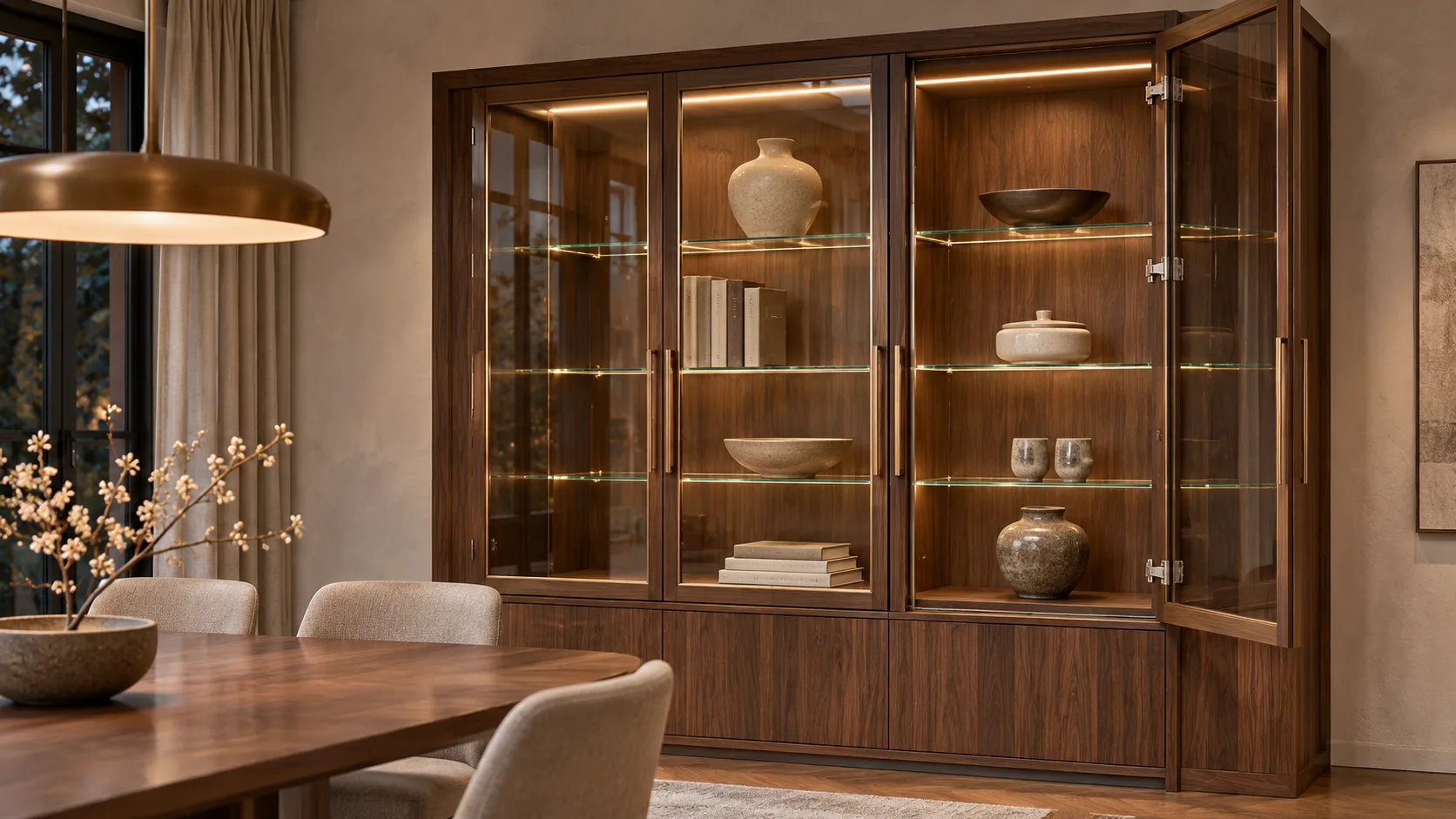
Planning example: a dining-room cabinet will display ceramics, glassware and a small collection of books. The lower shelves carry the heavier books on short spans, while upper shelves hold lighter objects. The design team compares low-iron clear doors with subtly textured doors, then chooses clear doors because accurate colour is important. Hinge positions, shelf supports, LED channels and cable access are frozen before glass processing. This is a planning scenario, not a completed commission or a universal glass specification.
Lighting needs its own miniature brief
Integrated lighting changes how the glass, objects and joinery are seen. Decide whether light should wash the back panel, graze shelf edges or illuminate each compartment. Avoid visible points reflected repeatedly in the glass. Allow a concealed but accessible route for drivers and connectors, and manage heat according to the selected lighting equipment. A cable drilled through a shelf corner after manufacture is not an acceptable coordination strategy. Review a sample with the actual glass, background, shelf edge and colour temperature before approving the full cabinet.
Fabrication and sample checklist
Issue a glass and hardware schedule that can be checked before manufacture.
- List displayed objects and intended shelf loads
- State glass type, build-up, processed size and edge finish
- Dimension every hole, notch and cut-out from fixed datums
- Name shelf supports, hinges, pulls, locks and protective pads
- Confirm door swing, neighbouring clearances and removal route
- Coordinate LED channels, drivers, cables and ventilation
- Approve a representative glass, edge and lighting sample
- Define delivery inspection for chips, scratches, distortion and hardware fit
Quality, cleaning and replacement
Agree which visual characteristics will be reviewed, from normal viewing positions and lighting, before delivery. Glass may show reflections, optical variation or small marks differently under grazing light, so acceptance should follow an agreed inspection method rather than an unrealistic demand for perfection. Leave enough clearance to clean both sides of doors, shelf edges and tracks. Record how a shelf or door can be removed without dismantling the whole cabinet, and retain the processed dimensions and hardware references for future replacement.
Important limitations
This guide does not determine glass thickness, shelf capacity or safety classification for a specific cabinet. Those decisions depend on geometry, support, edge condition, loads and applicable standards. A glass pane and its fittings must be checked as an assembly by the responsible designer, fabricator and hardware supplier. Do not place unverified heated equipment, heavy stone objects or valuable collections on a generic shelf detail. Installation should protect finished edges and avoid hard contact between glass and metal or masonry unless the approved system specifically permits it.
A sensible next step
Before fabrication approval, ask for one coordinated cabinet elevation and section plus a glass schedule. Cross-reference every pane to its type, finished size, edge, machining, hardware and shelf load. Review the schedule with the joiner, glass processor, hardware supplier and lighting specialist, then sign off a representative sample. This short coordination step is more valuable than choosing glass from a small swatch without seeing how the full assembly will work.
Sources & further reading
Make this useful for your project.
A review of your property and priorities can turn general guidance into a defined brief.
Explore Custom furnitureDiscuss your project