Brief the sitting experience before the silhouette
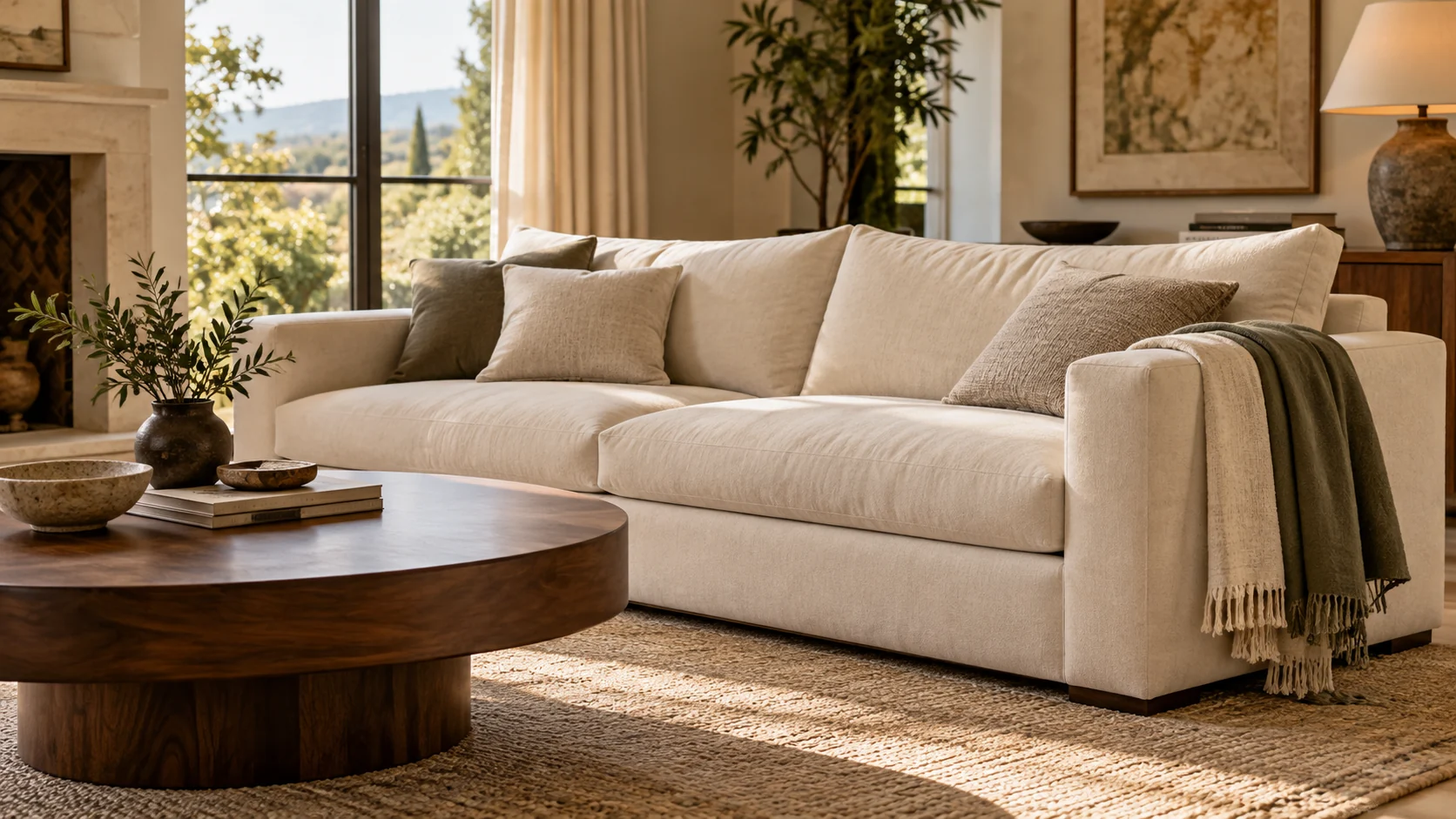
A custom sofa brief should explain how the household wants to sit, how the piece fits the room and how its comfort will be reviewed before manufacture. A reference photograph can describe the desired character, but it cannot establish seat feel, useful seating space or delivery feasibility. Begin with the people who will use it and the activities it must support. Then ask the designer and maker to translate those needs into dimensions, construction choices, samples and approval stages. Bespoke furniture is most useful when it solves a particular requirement; custom dimensions alone do not guarantee comfort.
Separate lounging from upright conversation
Describe the positions people actually prefer. A sofa used mainly for evening films may be judged differently from one used for conversation with guests. Identify whether occupants like to sit upright, tuck their legs under them or stretch out, and whether everyone shares the same preference. If those needs conflict, consider a mix of sofa and occasional seating instead of forcing one piece to suit every person. Ask each regular user to describe a seat they find comfortable and what they like about it. These observations are more useful than requesting a sofa that is simply deep, firm or luxurious without a shared understanding of those words.
Read the dimensions as a complete arrangement
Review overall width and depth alongside the usable seat, arms, back cushions and surrounding furniture. A wide outer dimension does not necessarily provide the seating capacity the household expects. Place the piece on a measured room plan with doors, curtains, side tables and normal circulation. Ask the designer to show what happens when someone stands up, passes the sofa or uses the coffee table. Check the view from the entrance as well as the view from the seats. For a sectional arrangement, discuss how the corner will be used and whether the long return supports or obstructs the room’s everyday movement.
Agree how comfort will be tested
Ask the maker what evidence can be reviewed before commitment: an existing comparable seat, a sample cushion, a prototype or another clearly defined trial. Record what the trial represents and where the final piece will differ. Sit in the intended positions and allow enough time to notice support and ease of getting up, rather than judging by a brief touch. If no representative trial is available, recognise that the comfort decision carries more uncertainty and discuss how that will be handled. Keep appearance approval separate from comfort approval so accepting a drawing or fabric swatch is not mistaken for acceptance of the complete seating experience.
Choose upholstery using more than one performance number
Kvadrat’s product information distinguishes abrasion, pilling and lightfastness, and warns that high abrasion-test results are not a direct prediction of product lifespan. Use that distinction when asking for evidence on a shortlisted textile. A single impressive number does not describe the whole experience of living with an upholstered piece. Ask the supplier to explain the exact fabric’s suitability, care information and expected appearance characteristics for your intended use. Review the colour and texture on an appropriately sized sample, but do not infer a cleaning method from the fibre name or assume that a removable-looking cover is intended for washing.
Planning example: a sofa for films and weekend guests
Imagine a household that wants a low, relaxed sofa for evening films but also hosts relatives who prefer a more upright seat. The initial reference image shows a very deep modular arrangement. Instead of copying it, the designer compares a more moderate sofa with two supportive occasional chairs. The family reviews a comparable seat and records which cushions and back support they prefer. On the room plan, the chosen arrangement also leaves a clearer route to the balcony. A textured neutral upholstery is shortlisted only after the supplier provides its actual care guidance. This planning example does not prescribe universal seat dimensions or claim that one construction suits everyone. It shows how a mixed seating brief can resolve conflicting needs more effectively than enlarging the sofa.
Review the details that photographs leave out
Ask how seams, cushions, legs and the back of the sofa will appear, especially if the piece sits away from a wall. Discuss which components are removable or replaceable and what ongoing adjustment or care the owner should expect. Request clarity on how the approved textile will be used where pattern, texture or direction matters. The drawing should connect these decisions to the chosen configuration rather than leaving them to assumptions at fabrication. If the room contains retained furniture, bring those dimensions and finishes into the review so the new piece has a deliberate relationship with what is already there.
Prove the delivery route before fabrication
Confirm who measures and reviews the route from arrival point to final position, including building access, lifts, stairs, doorways and turns where relevant. Ask whether the proposed piece is delivered as one unit or in sections, and what assembly is expected on site. Do not assume that a sofa fitting on the room plan can reach the room. Establish responsibility for delivery bookings, protection, packaging removal and any installation work. The supplier’s lead time and delivery commitments should be obtained for the actual specification and location; a general showroom estimate is not a guaranteed date for a custom order.
A pre-fabrication checklist
Use the checklist to distinguish a preferred design from a piece ready to manufacture. Link every approval to the current drawing and specification so a later fabric or dimension change is reviewed properly. Where uncertainty remains, ask the maker what further sample or information would meaningfully reduce it.
- The intended activities and the preferences of regular users are recorded.
- The measured room plan includes surrounding furniture and normal movement.
- Overall dimensions and usable seating are understood separately.
- The comfort trial and its limits are documented.
- Fabric identity, colour, suitability and care guidance are retained.
- Seams, cushions, legs and visible rear details have been reviewed.
- Delivery route, modular assembly and installation responsibilities are confirmed.
- Commercial terms and the effect of changes after approval are clear.
Bring a short brief to the furniture discussion
Prepare room photographs, approximate dimensions, retained furniture details and a few reference images with a reason for each. Add a sentence about what is uncomfortable or impractical in the current seating. Ask for a proposal that includes the design outputs, sample review and delivery checks needed to reach a confident decision. The aim is a piece that earns its place through proportion, comfort and everyday usefulness. If the project involves broader room changes, connect the sofa brief to the interior design process before its dimensions become a fixed constraint.
Sources & further reading
Make this useful for your project.
A review of your property and priorities can turn general guidance into a defined brief.
Explore Custom furnitureDiscuss your project